
GPT-6 Astra for Building Apps
Transitioning from static web pages to interactive software: How AI participates in complex state management, data architecture, and application logic.
Building a static website is fundamentally an exercise in presentation. You are arranging visual elements on a grid, defining typography, and ensuring the layout gracefully reflows across different screen sizes. Building a software application, however, introduces exponentially higher layers of complexity. It requires managing asynchronous data flows, persisting user state across sessions, securing authenticated routes, optimizing database queries, and gracefully handling the inevitable network errors that occur in production environments.
When developers first attempt to transition from building websites with AI to building applications with AI, they often hit a harsh plateau. The prompts that successfully generated a beautiful marketing landing page completely fail when tasked with generating a real-time, multi-tenant SaaS dashboard. The AI produces fragmented, hallucinated components that look correct visually but contain critical logic flaws, memory leaks, and broken state synchronization beneath the surface.
GPT-6 Astra represents a massive leap forward in bridging this gap. Because of its enhanced reasoning capabilities and its ability to process entire repository structures rather than just isolated files, Astra is uniquely positioned to handle application development. However, wielding it effectively requires a completely different operational mindset. You cannot simply ask Astra to "build an app." You must learn how to architect, specify, test, and iterate on complex software systems alongside an autonomous agent. This article will deconstruct exactly how to execute that workflow.
Astra Architecture: From Concept to Application Design
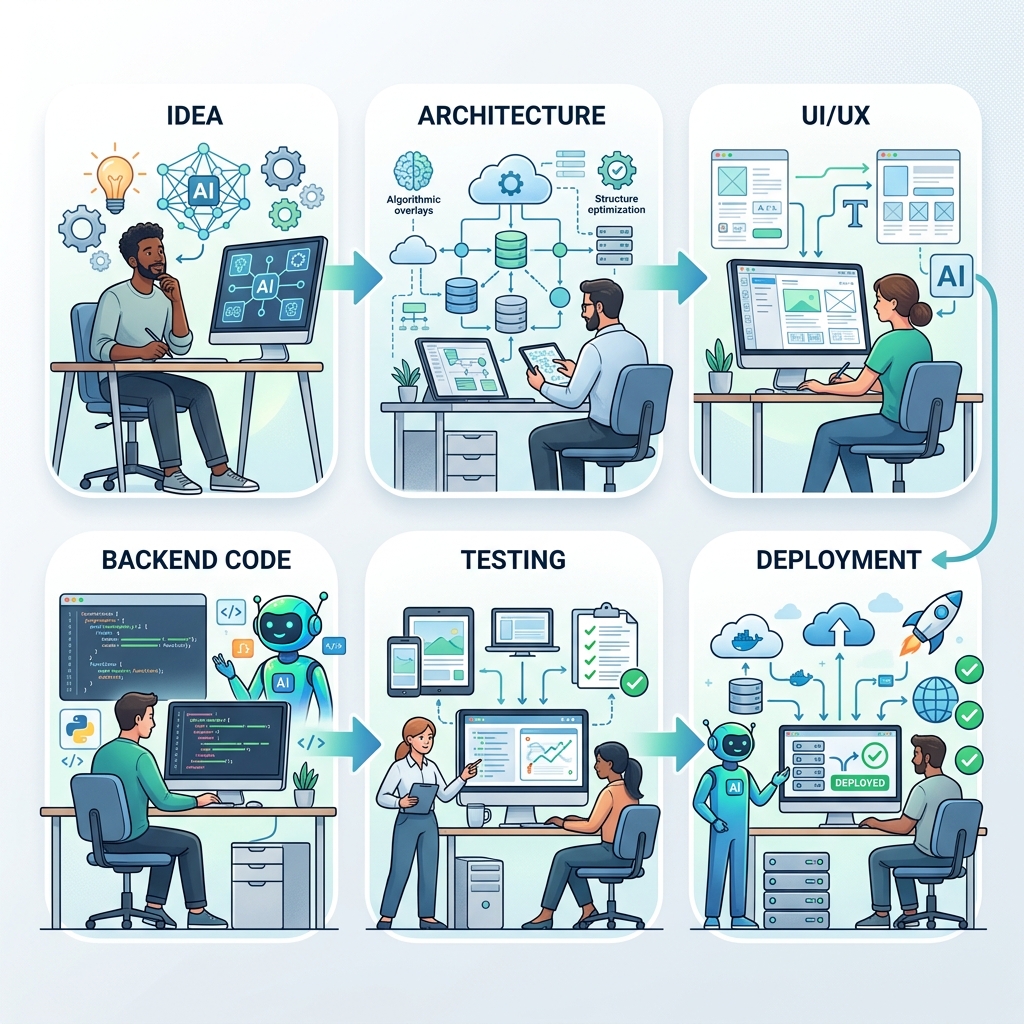
The traditional application development workflow is a rigid, specialized assembly line. Product managers define the user stories, UX designers create the wireframes, system architects design the database schema and API contracts, backend engineers build the endpoints, frontend engineers consume the endpoints to build the interface, and QA engineers try to break it all. This fragmentation is necessary for human teams to scale, but it creates massive communication overhead and information silos.
When utilizing earlier iterations of large language models, developers had to artificially recreate this fragmentation. You had to ask the AI to write the SQL schema in one prompt, ask it to write the Express API in a separate conversation context, and then carefully coax it into writing a React component that matched the exact JSON structure the API was supposed to return. If you made a mistake bridging those contexts, the application failed silently.
GPT-6 Astra changes this architectural paradigm entirely through its expanded context window and deep structural reasoning. Because Astra can hold and analyze the entire application state simultaneously, it operates as a full-stack reasoning engine. It understands that changing a column type in your PostgreSQL schema must cascade into updating your Prisma client, which requires modifying the Next.js API route, which ultimately mandates rewriting the TypeScript interface on the frontend component. It sees the systemic relationship between the layers.
Furthermore, Astra's ability to utilize computer-use agents means it can actually execute these cascading changes across your local file system, run the database migrations, start the local development server, and attempt to interact with the resulting application. It shifts the AI's role from a passive "code dictator" that spits out text blocks into an active "systems integrator" that tries to piece the puzzle together in reality.
This is incredibly empowering, but it also amplifies the consequences of poor planning. Because Astra can autonomously write thousands of lines of code across dozens of files, a fundamental architectural flaw in your initial instructions will be magnified across the entire codebase. If you do not specify how authentication tokens should be handled securely, Astra will implement a flawed, insecure approach comprehensively across every single route. Therefore, the human operator must transition from being a syntax writer to being a strict, uncompromising software architect.
Continue reading with Premium
Unlock the complete guide to Astra's application workflow, practical technical prompts, backend integration, and the exact step-by-step professional process for software.
Upgrade to Premium →